Scaling up
As the usage of your ThingPark Enterprise platform grows up, your deployment may reach the limits of your current hardware sizing. You should scale up your deployment to ensure that the hardware resources (CPU, RAM and disk) fulfill the requirements of your usage.
Once the hardware resources are updated, you must apply the new sizing to the ThingPark Enterprise platform using the TPE Configuration Cockpit module.
Hardware resource sizing update
Self-hosted TPE standalone (1 node):
- Stop, update the server and restart the TPE node. See Stopping and starting TPE software or instance
- Go to the TPE Services Cockpit module and wait for all groups in the Infra and Services sections to be running.
Self-hosted TPE HA (3 nodes):
- Stop, update the server and restart the TPE node 2. See Stopping and starting TPE software or instance
- Go to the TPE Services Cockpit module and wait for all groups in the Infra and Services sections to be running.
- Stop, update the server and restart the TPE node 1. See Stopping and starting TPE software or instance
- Go to the TPE Services Cockpit module and wait for all groups in the Infra and Services sections to be running.
The node 3 (called arbiter node) has the same size for all segments. Only the nodes 1 and 2 should be updated. Nevertheless, if the node needs to be updated, it should be updated and restarted between nodes 2 and 1.
Storage size update
After you increase the size of the storage, you must extend the file system to take advantage of the increased storage capacity.
For each TPE node :
-
Go to the Storage Cockpit module
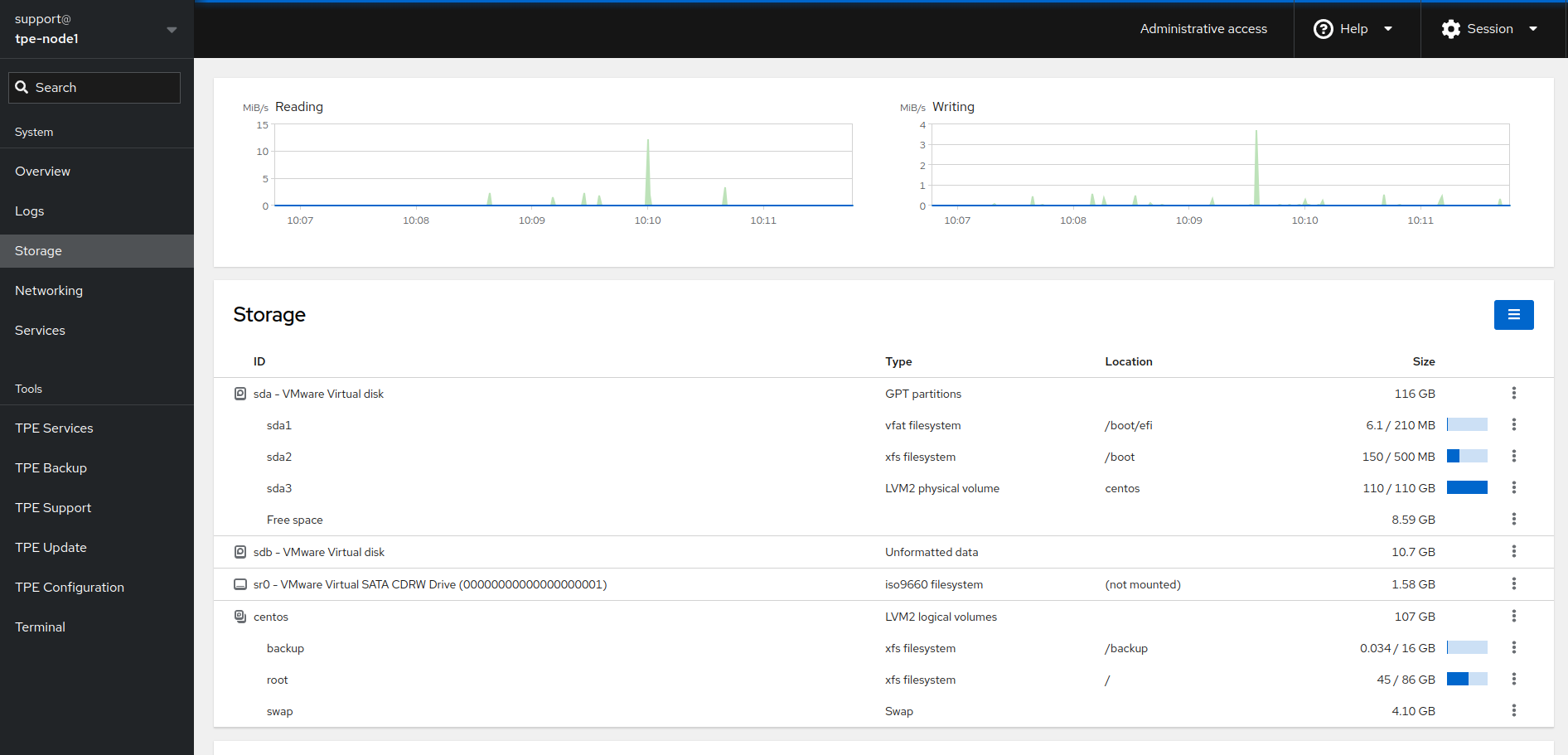
If the volume group list is empty and your TPE host is an AWS virtual server, increase the size of the disk attached to the virtual machine and follow this dedicated procedure.
If the volume group list is empty and your TPE host is an Azure virtual server, increase the size of the disk attached to the virtual machine and restart.The file system will be extended automatically by your cloud provider. You can then skip the remaining Storage Size Update steps for this node.
Otherwise, follow the standard procedure below. -
Add a new disk to the TPE host, and select "Add a Physical volume" to the "centos" volume groups

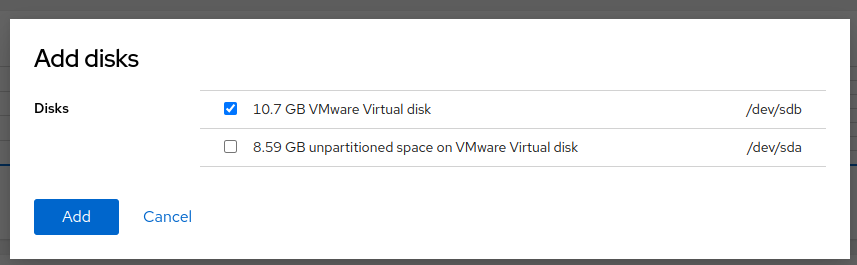
-
Select the root logical volume and select "Grow"

-
Use the maximum size and apply this configuration.
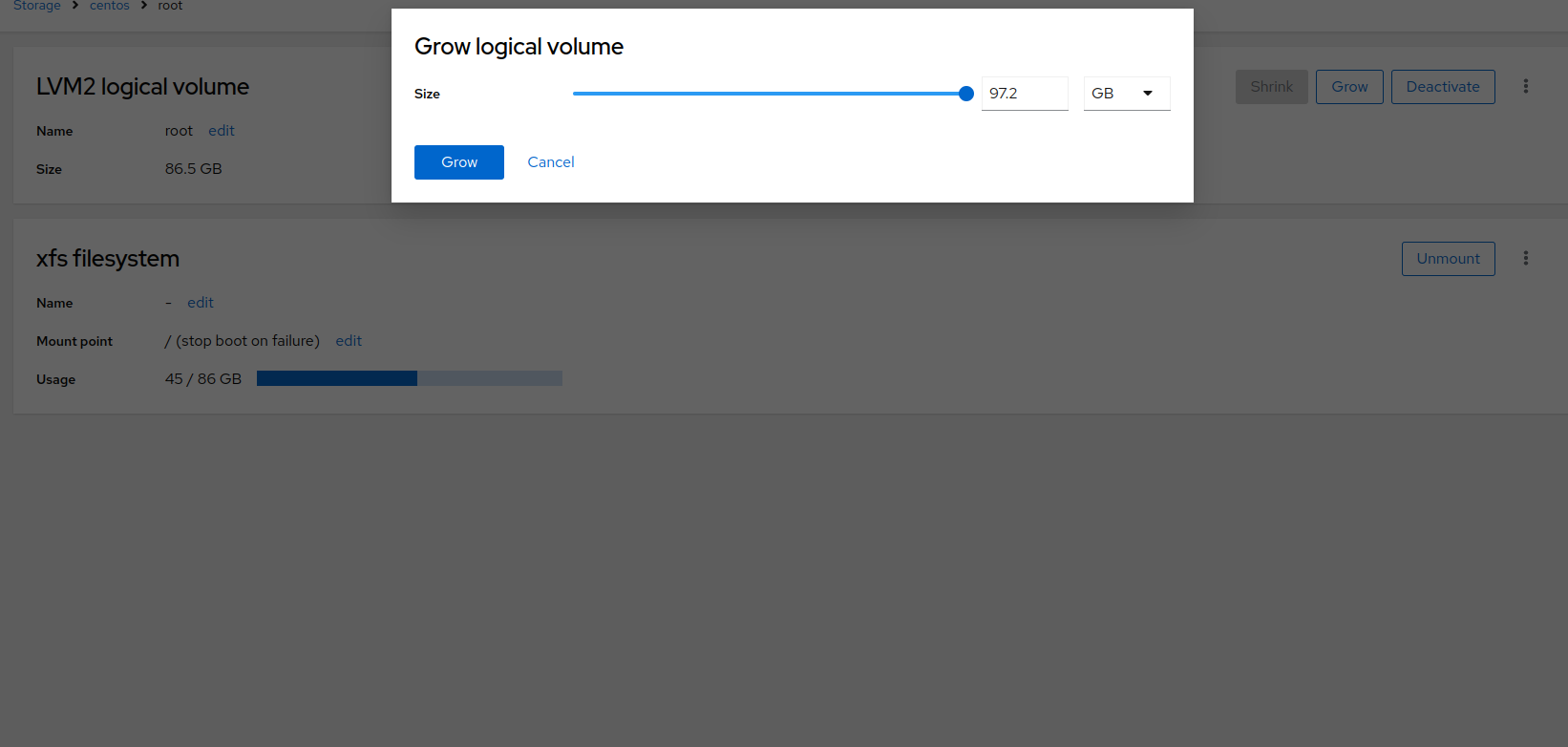
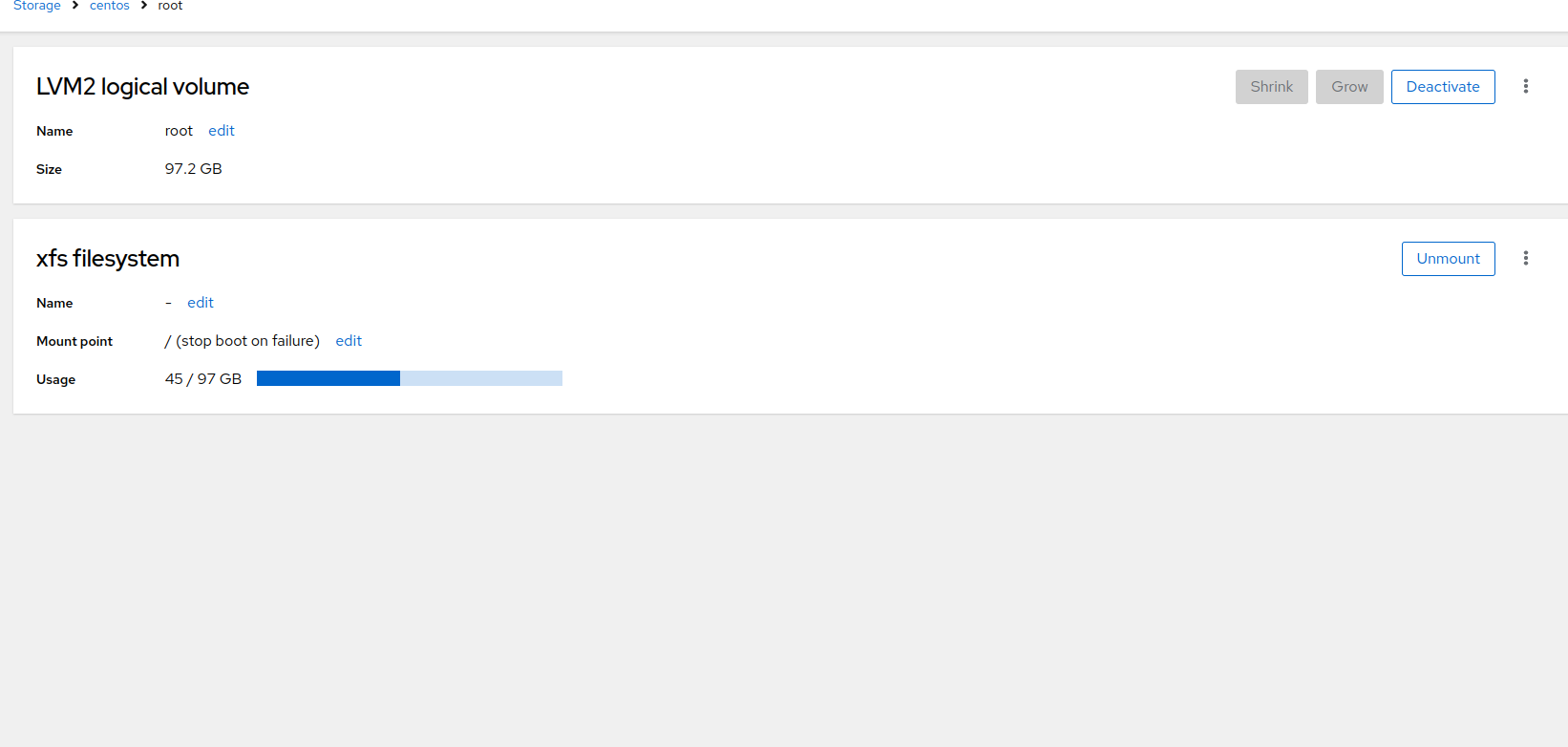
AWS Storage size update
If your TPE host is an AWS virtual server and has initially been deployed with AlmaLinux 8, you must follow this procedure to extend the disk.
For each TPE node :
-
Open the "Terminal module" in Cockpit.
-
Execute the
lsblkcommand to display the disk name and partitions:
$ lsblk
NAME        MAJ:MIN RM  SIZE RO TYPE MOUNTPOINT
nvme0n1     259:0    0   70G  0 disk
├─nvme0n1p1 259:1    0    1G  0 part /boot
├─nvme0n1p2 259:2    0   15G  0 part /backup
├─nvme0n1p3 259:3    0  3,8G  0 part [SWAP]
├─nvme0n1p4 259:4    0    1K  0 part
└─nvme0n1p5 259:5    0 50,2G  0 part /
-
Identify the root partition ( / mountpoint) and the free space (partition without mountpoint) names.
Names are composed with disk name (e.g. nvme0n1) and a partition identifier (e.g. p4 and p5 on this example). -
Run the following commands to resize your root partition (replace nvme0n1 with your actual disk name, 4 with the free partition and 5 the root partition identifiers):
sudo growpart /dev/nvme0n1 4
sudo growpart /dev/nvme0n1 5
sudo xfs_growfs /
ThingPark Enterprise sizing update
Once the hardware resources are updated, you must apply the new sizing to the ThingPark Enterprise platform using the TPE Configuration Cockpit module.
-
In Cockpit, go to TPE Configuration
-
Go to the bottom of the page and click Save & Apply.